
UV Water Purifiers — Chemical-Free Disinfection for Safer Tap Water
Ultraviolet (UV) water purifiers use germicidal UV‑C light to disinfect drinking water without adding chemicals. Properly sized systems inactivate bacteria, viruses, and many protozoa, giving homes and businesses a chemical‑free layer of protection for tap water. This guide explains how UV‑C (centered near 254 nm) works, what parts make up a UV system, and why many people choose UV to preserve taste and avoid chemical byproducts. You’ll find practical guidance on installation and routine care, comparisons of whole‑house versus point‑of‑use units, cost and local considerations for Grosse Pointe properties, and answers to common questions about lamp life and pathogen coverage. We weave selection basics — flow rate, pre‑filtration, and water source — with industry terms like UV dose (mJ/cm²), quartz sleeve care, and flow‑rate matching so you can decide when UV belongs in a multi‑barrier treatment plan and how local pros can size, install, and maintain systems for reliable, chemical‑free disinfection.
How UV Water Purification Works
UV water purification disinfects flowing water by exposing it to ultraviolet‑C radiation, typically around the germicidal 254 nm wavelength. UV photons are absorbed by microorganisms’ DNA or RNA and create lesions that stop replication — rendering bacteria, viruses, and protozoa inactive without changing dissolved minerals or overall water chemistry. The key to performance is the delivered UV dose, which depends on lamp intensity, exposure time, and flow rate: faster flow shortens exposure and requires proper system sizing to keep dose levels effective. Knowing the main system parts makes clear why pre‑filtration and regular lamp maintenance are critical for steady, long‑term performance.
This table highlights the core components, what they do, and basic maintenance notes so you can judge system fit for your property.
| Component | Function | Value |
|---|---|---|
| UV lamp (germicidal) | Emits UV‑C light near 254 nm to inactivate microorganisms | Replace roughly every 9–12 months; monitor intensity when possible |
| Quartz sleeve | Protects the lamp from water while transmitting UV light | Clean regularly to prevent fouling and keep UV transmittance high |
| UV chamber | Holds water during exposure; engineered for even dose distribution | Chamber material and shape affect dose uniformity and cleaning access |
| Pre-filter (sediment/carbon) | Removes turbidity and particles that could shield microbes from UV | Required when turbidity exceeds recommended limits; change schedule varies |
| O-rings and fittings | Seal plumbing connections and preserve system integrity | Inspect at service intervals and replace if signs of wear appear |
How UV Light Inactivates Waterborne Pathogens
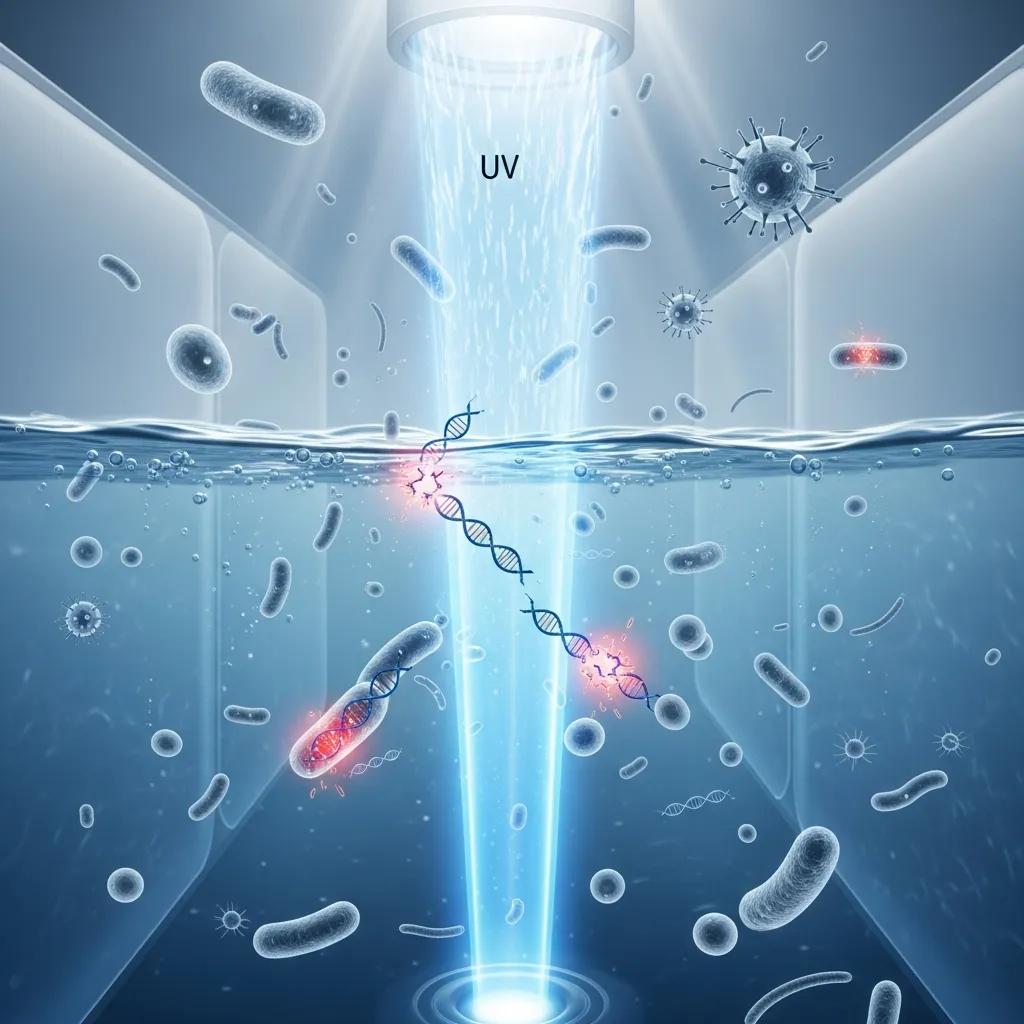
UV light delivers energy that directly damages nucleic acids, creating thymine dimers in DNA and similar lesions in RNA that block replication and transcription. The controlling metric is UV dose (measured in millijoules per square centimeter, mJ/cm²), a product of irradiance and exposure time that determines achievable log‑reductions for specific organisms. Different microbes need different doses — bacteria and many viruses typically require lower doses than some resistant protozoa — so matching the chamber’s output to the correct flow rate and lamp power is essential for reliable control. Industry guidance now stresses dose verification and regular monitoring to keep delivered intensity within safe margins.
Knowing those dose needs points directly to the hardware and servicing practices needed to deliver and protect the required UV energy; the next section breaks those pieces down.
Key Components of a UV Water Purification System
A UV system combines a germicidal lamp, a protective quartz sleeve, a flow‑designed chamber, pre‑filtration, and the necessary plumbing and electrical connections to deliver a consistent germicidal dose at the target flow. The lamp is the UV source, the sleeve preserves optical clarity while keeping the lamp dry, and chamber geometry helps ensure even exposure across the water column. Pre‑filters shield the lamp and sleeve from sediment and turbidity that reduce UV transmittance, and routine maintenance — lamp replacement and sleeve cleaning — keeps output steady. Choosing the right components and service intervals is essential for long‑term performance; later sections cover maintenance in detail.
With that technical foundation, we’ll look at the practical benefits of choosing UV over chemical disinfectants.
Benefits of Chemical‑Free UV Water Disinfection
UV disinfection delivers fast, high‑efficacy pathogen inactivation without adding residual chemicals, so water taste stays intact and disinfection byproducts (formed when chemicals react with organic matter) are avoided. UV works instantly at the point of flow, requires limited day‑to‑day input, and pairs well with pre‑ and post‑treatment steps as part of a multi‑barrier strategy. For households and businesses concerned about flavor, aquariums, food prep, or chemical handling, UV removes the need for chlorine taste and odor. From an environmental and operational view, UV reduces chemical handling, eliminates continuous chemical discharge, and usually requires a smaller footprint than ongoing chemical dosing systems.
Key practical benefits include:
- High pathogen inactivation: properly dosed UV delivers strong log reductions for bacteria and viruses.
- No chemical byproducts: UV does not create trihalomethanes or similar disinfection byproducts.
- Taste and odor preservation: minerals remain intact, so flavor for drinking and cooking is unchanged.
- Low day‑to‑day maintenance: scheduled lamp changes and sleeve cleaning replace daily chemical monitoring.
Those advantages make UV attractive for sensitive uses, but keep in mind that effective UV requires correct pre‑filtration and monitoring to sustain results.
In the Grosse Pointe area, Frost & Kretsch Plumbing can evaluate your water, recommend whole‑house or point‑of‑use UV sizing, and provide local installation and maintenance. Our licensed, insured technicians serve Grosse Pointe and nearby Macomb, Oakland, and Wayne Counties with on‑site testing, equipment selection help, and routine servicing to keep UV systems delivering chemical‑free disinfection.
How Frost & Kretsch Plumbing Helps Grosse Pointe Customers
We offer local UV water purifier services focused on accurate assessment, correct system sizing, professional installation, and dependable maintenance for both homes and businesses in the Grosse Pointe area. Our licensed technicians perform on‑site water testing and flow measurements to select a system that delivers the required UV dose at your property’s flow rate, and we recommend pre‑filtration when turbidity or sediment could reduce UV effectiveness. Installations include mounting the UV chamber, integrating electrical controls, connecting pre‑filter loops as needed, and commissioning with performance checks for lamp output and alarms. For long‑term reliability, we provide scheduled maintenance visits — lamp replacement, sleeve cleaning, and pre‑filter changes — to extend equipment life and keep disinfection performance on target.
Frost & Kretsch’s local service process includes:
- On‑site assessment and testing: We measure flow and water quality to determine system needs.
- System selection and pre‑filtration design: We recommend a whole‑house or point‑of‑use solution and the filters required.
- Professional installation and commissioning: Plumbing, electrical hookup, and performance validation complete the job.
This local approach reduces the risk of incorrect sizing and improves the odds your UV purifier will deliver consistent chemical‑free disinfection.
What Professional UV Installation Involves
Professional installation starts with a site assessment that measures peak flow, checks turbidity and basic microbial indicators, and identifies a convenient mounting and power location for the UV chamber. After choosing the right pre‑filtration (sediment or carbon as needed), technicians mount the chamber, install the lamp and quartz sleeve, connect plumbing and electrical supply, and set up any controls or alarms. Commissioning includes verifying lamp intensity, checking for leaks, and running validation samples when appropriate to confirm the delivered UV dose matches design targets. Proper installation minimizes the chance of under‑dosing from excess flow or fouled sleeves and supports long‑term reliability.
Those installation steps naturally lead into the maintenance needed to keep UV systems operating at peak performance.
Maintenance and Repair of UV Water Purifiers
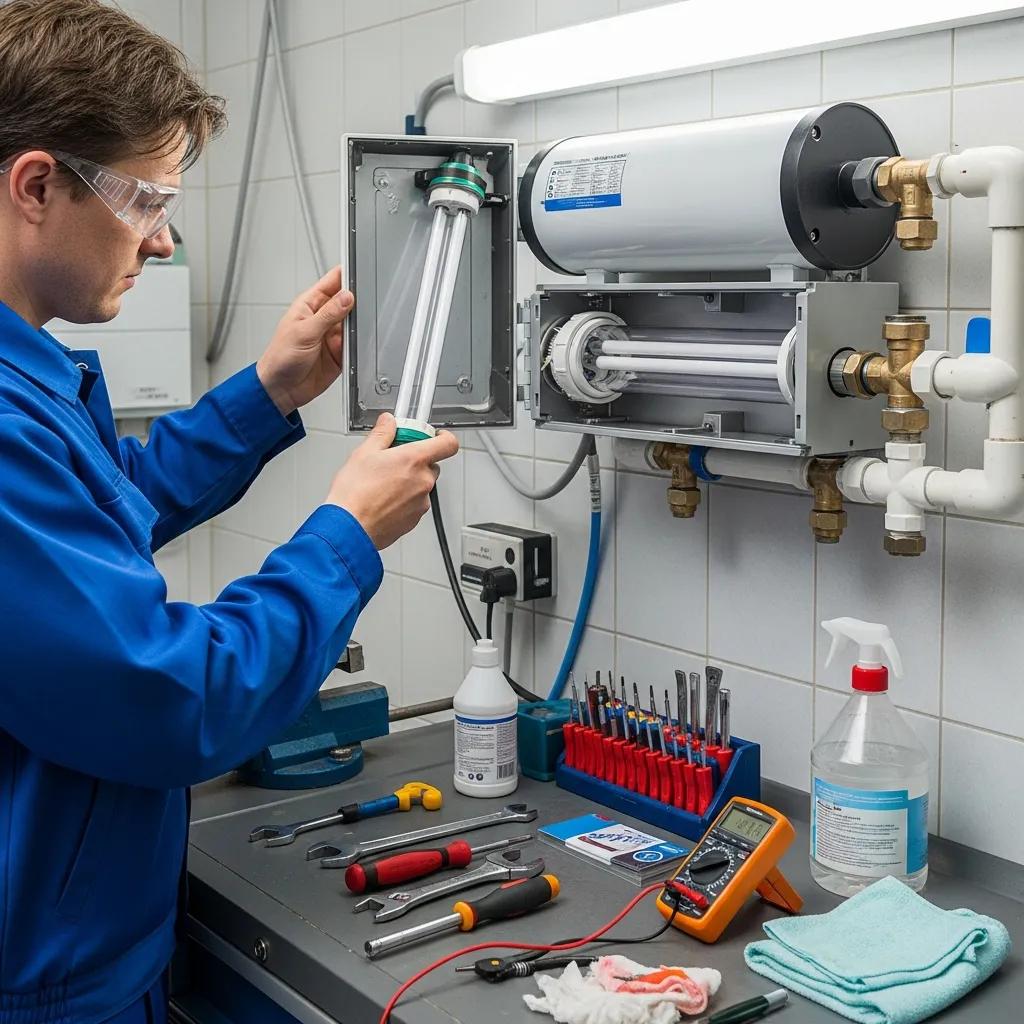
Routine care centers on annual lamp replacement, periodic quartz sleeve cleaning, and scheduled pre‑filter changes to prevent loss of UV transmittance and preserve dose delivery. Typical service intervals are lamp replacement every 9–12 months (manufacturer guidance varies), sleeve cleaning when deposits appear, and pre‑filter cartridge changes based on turbidity and use. Signs a UV system needs service include reduced flow, alarm activation, visible sleeve fouling, or test results showing diminished microbial control. When repairs are required, licensed technicians can replace lamps and sleeves, test system output, and troubleshoot electrical or plumbing faults to restore chemical‑free disinfection performance.
Use this maintenance checklist to plan routine service:
- Replace the UV lamp annually to keep germicidal output within specification.
- Clean or inspect the quartz sleeve quarterly or as needed depending on fouling.
- Change pre‑filter cartridges on the manufacturer’s schedule to prevent turbidity shielding.
- Test water and check system alarms after service to confirm restored performance.
Which UV Systems Work Best for Homes and Businesses?
Deciding between whole‑house (point‑of‑entry) and point‑of‑use UV systems comes down to coverage needs, flow rates, and application. Whole‑house units treat all incoming water and protect showers, laundry, and every tap; point‑of‑use units treat a single faucet or appliance for focused protection. Commercial settings usually need higher flow‑rated chambers, redundant lamps, or modular systems to maintain dose during peak demand, while residential systems prioritize compact chambers sized to household peak flow. Well water often needs pre‑filtration for turbidity and iron before UV, whereas municipal water may use UV as an added barrier without heavy pre‑treatment. Check GPM requirements and lamp life to match system type to your use case.
| System Type / Model | Typical Flow Rate (GPM) | Lamp Life / Maintenance | Application |
|---|---|---|---|
| Whole‑house (POE) UV system | 5–15 GPM for single‑family homes; higher for larger systems | Replace lamp ~9–12 months; clean sleeve as needed | Treats all water entering a home or small business |
| Point‑of‑use (POU) under‑sink UV | 0.5–2 GPM | Replace lamp ~9–12 months; compact form factor | Treats drinking water at a single tap |
| Commercial / high‑flow UV chamber | 20+ GPM with modular lamp arrangements | Lamp and module maintenance per manufacturer schedule | Restaurants, small industry, multi‑unit buildings |
| Compact in‑line UV sterilizer | 1–6 GPM | Low maintenance; periodic lamp change | Appliances, RO post‑treatment, specific fixtures |
Whole‑House vs. Point‑of‑Use UV Filters
Whole‑house (point‑of‑entry) UV filters treat all incoming water, protecting showers, laundry, and kitchen taps from microbial risk and providing a single treatment point for the property. Point‑of‑use units are smaller, installed at a specific faucet or appliance so only drinking or cooking water passes through UV. Whole‑house units require larger chambers sized for peak flow, while point‑of‑use units cost less and are simpler to install but cover fewer outlets. The choice balances budget, desired coverage, and whether you need whole‑home protection or just potable‑water treatment.
Well Water vs. City Water: How UV Fits
Well water often has higher turbidity, sediment, or iron that can shield microorganisms from UV exposure, so pre‑filtration (sediment and sometimes iron removal) and water testing are usually required before installing UV. Municipal water is typically lower in turbidity but can still benefit from UV as an extra barrier, especially where microbial risk exists or as redundancy without chemical dosing. Well owners should get on‑site testing for turbidity, microbial indicators, and flow characteristics to choose the right pre‑filters and chamber size. Treat the source correctly so the UV dose reaches target organisms and maintains chemical‑free disinfection effectiveness.
Costs and Value of UV Installation in Grosse Pointe
Costs vary with unit class, required flow rate, pre‑filtration needs, plumbing complexity, and local labor rates. Equipment prices span a wide range, and installation can rise when electrical work or plumbing reroutes are needed. The value of UV includes lower ongoing chemical costs, preserved water taste, and strong pathogen control when systems are properly sized — benefits that can offset the initial investment over time for households and businesses prioritizing chemical‑free disinfection. Local factors like installer availability, existing plumbing layout, and the need for on‑site water testing also affect price and schedule. For accurate local pricing and ROI estimates, request an on‑site assessment and a written quote.
This table outlines common cost drivers and how they typically affect installation price so homeowners know what to expect.
| Cost Factor | Typical Range | Local Impact on Installation Price |
|---|---|---|
| Unit selection (POU vs POE) | Lower (POU) to higher (POE / commercial) | Larger whole‑house units raise equipment and labor costs |
| Pre‑filtration needs | Minimal to significant | Additional filter housings and cartridges add to the bill |
| Plumbing modifications | Simple hookup to complex reroute | Complex reroutes increase labor time and cost on site |
| Electrical work | Standard outlet to dedicated circuit | Involves electrician time and parts — raises total cost |
Factors That Influence System Price
Price drivers include chamber capacity versus peak flow, the need for sediment or iron removal pre‑filters, any required plumbing or electrical work, and whether commercial‑grade redundancy or monitoring is requested. Brand and model choices affect initial equipment cost and replacement lamp pricing, while installation complexity and local labor rates determine service expense. Before requesting quotes, compile a checklist — household peak flow estimate, water source (well or municipal), existing filtration, and available installation space — to ensure accurate, comparable estimates and reduce surprises.
Why Professional Installation Matters
Professional installation makes sure the UV chamber matches household or facility peak flow, pre‑filtration prevents turbidity‑related shielding, and electrical and plumbing connections meet code and function correctly. Wrong flow‑rate matching or inadequate pre‑filtration can let delivered UV dose fall below required levels, leaving you under‑protected even if the system looks operational. Professional commissioning includes intensity checks and validation samples when needed, confirming real‑world performance rather than theoretical numbers. Investing in a qualified installer reduces maintenance issues and improves the chance that your chemical‑free disinfection goals are met consistently.
Common Questions About UV and Chemical‑Free Disinfection
Below are concise answers to the questions people ask most often about lamp life, pathogen coverage, and the limits of UV as a non‑chemical approach. These short answers help homeowners and facility managers prepare the right questions before contacting a local provider. When appropriate, schedule an assessment for recommendations tailored to your property.
How Often Should UV Lamps Be Replaced?
Manufacturers and industry guidance generally recommend replacing UV lamps every 9–12 months to maintain germicidal output, even if the lamp still glows visibly. Lamp aging reduces UV intensity before visible failure, so annual replacement preserves the required dose and disinfection performance. Track lamp hours and replace lamps and sleeves on schedule; technicians often perform intensity checks during service visits to confirm output. For scheduled replacements and safe lamp disposal, contact a licensed technician.
If you’d like a maintenance plan for your property, Frost & Kretsch Plumbing offers lamp replacement and system checks as part of routine service options.
Does UV Effectively Inactivate Viruses and Bacteria?
Yes — when a system is correctly designed and dosed, UV reliably inactivates a broad range of bacteria and viruses and can achieve high log‑reductions for common pathogens. UV also works against many protozoa, though some resistant species require higher doses or complementary treatments. Note that UV does not remove dissolved chemicals, heavy metals, or particulates, so it’s best used within a multi‑barrier plan that includes filtration and any chemical removal methods needed. For comprehensive protection, combine UV with the appropriate pre‑ and post‑treatment steps based on water testing results.
For a personalized assessment of pathogen risk and recommendations on multi‑barrier strategies, schedule an on‑site test and estimate with a licensed local provider.
Frequently Asked Questions
What maintenance is required for UV water purifiers?
Keep your UV system effective by replacing the lamp about every 9–12 months, cleaning the quartz sleeve periodically to remove fouling, and changing pre‑filters based on usage and water quality. Regularly check system alarms and perform periodic water testing to confirm the system is functioning and providing safe drinking water.
Can UV water purifiers remove heavy metals from water?
No. UV purifiers do not remove heavy metals or dissolved chemicals. Their role is to inactivate microorganisms with UV‑C light. For chemical or heavy‑metal removal, pair UV with filtration methods such as activated carbon or reverse osmosis, which address those contaminants effectively.
How does UV compare to traditional chemical disinfection?
UV offers quick pathogen inactivation without introducing residual disinfectants, so it preserves taste and avoids harmful byproducts. It requires routine maintenance and proper pre‑filtration. Chemical methods can be simpler to apply continuously but may affect taste and create disinfection byproducts. Often, a multi‑barrier approach that combines methods gives the best overall safety.
What should I consider when choosing a UV system?
Consider your peak flow rate, water source quality, and any turbidity or sediment. Match the system to peak flow to ensure adequate UV dose. Decide if you need whole‑house coverage or a point‑of‑use unit for a specific tap. Consulting a professional helps you assess these factors and choose the right system for your needs.
Are UV purifiers safe for all water sources?
UV works for municipal and well water, but well water often requires pre‑filtration for turbidity, sediment, or iron that can block UV. Municipal water usually needs less pre‑treatment but can still benefit from UV as an additional safety layer. Water testing is essential to determine proper pre‑treatment and system requirements for your source.
How long does installation take?
Installation time depends on plumbing and electrical complexity. A straightforward installation typically takes a few hours to a full day, including assessment, selection, and installing the UV chamber, lamp, and pre‑filters. More complex setups with plumbing reroutes or electrical upgrades may take longer. Ask your installer for a site‑specific timeline.
Conclusion
UV water purifiers offer a reliable, chemical‑free way to make drinking water safer by inactivating harmful pathogens while preserving taste. Their low day‑to‑day maintenance, lack of chemical byproducts, and compatibility with different water sources make UV a strong option for both homes and businesses. For tailored recommendations and professional installation in the Grosse Pointe area, contact local experts who can assess your water and design the right solution. Explore our services today to help ensure your water is safe and tasting its best.