Slab Leak Detection & Repair in Michigan — Expert Solutions for Homes and Businesses
Slab leaks — hidden breaks or failures in pipes beneath concrete foundations — can quietly damage a property, increase water bills, and create health hazards if left unchecked. This guide explains how slab leak detection and repair work, how to spot early warning signs, and which modern diagnostic tools and repair options deliver reliable results for both homes and businesses. You’ll learn to recognize clues like unexplained high water bills, warm spots in flooring, and foundation movement, and see how acoustic listening, infrared imaging, and sewer camera inspection pinpoint leaks with minimal disruption. We compare spot repair, rerouting, and trenchless methods so you can weigh invasiveness, timelines, and cost drivers common to Michigan’s soils and climate. Finally, we outline pricing factors and when to call a licensed professional for an on-site evaluation. Throughout, practical keywords like slab leak detection, foundation leak, trenchless slab leak repair, and acoustic leak detection are used in clear, actionable advice so property owners can protect value and limit repair scope through prompt, professional action.
What is a Slab Leak and Why is Immediate Detection Crucial?
A slab leak is a water leak in piping located under a building’s concrete slab. Immediate detection matters because even a small, ongoing leak can wash away soil, raise moisture beneath the slab, and speed up structural damage. When pressurized water escapes under concrete it displaces soil and weakens load-bearing support, which can cause settling, cracks, and long-term foundation problems. Finding leaks early shrinks the repair footprint, reduces water damage and mold risk, and lowers utility bills — protecting both health and property value. Knowing how these leaks start and spread helps owners act quickly and often avoids more extensive excavation later.
How Do Slab Leaks Affect Foundations and Plumbing Systems?
Slab leaks primarily affect foundations by saturating and eroding the soil beneath the slab, which changes how weight is distributed and can cause settling or uneven movement. Over time, migrating water can wash away fine soils and create voids that let concrete bend or crack; those shifts can also put extra stress on nearby plumbing, causing corrosion or joint failures and leading to more leaks. Understanding the chain reaction — leak to soil change to structural symptoms — helps prioritize diagnostics and decide whether a focused spot repair or a wider repipe is needed to stabilize both plumbing and foundation components.
What Are the Common Causes of Slab Leaks in Michigan Homes?
Typical causes include pipe corrosion, ground movement, poor installation, and freeze-thaw cycles that stress buried pipes — all factors that are common in Michigan’s seasons and soil types. Older copper or metal pipes corrode over time, while clay-rich soils expand and contract with moisture changes and can strain joints. Poor pipe bedding, sharp bends, or accidental damage during construction create weak spots under slabs that eventually fail. Identifying the likely cause during inspection helps determine whether a localized fix will do or if a reroute or trenchless repipe is the wiser long-term choice.
How Can You Recognize the Signs of a Hidden Slab Leak?

Hidden slab leaks usually show up as indirect clues homeowners can spot before obvious structural damage appears. Early recognition speeds diagnostics and keeps repairs smaller. The most reliable signs include unexplained spikes in your water bill, localized warm spots on floors (for hot-water leaks), persistent damp or musty odors, low water pressure, and the sound of running water when all fixtures are off. These symptoms guide simple homeowner checks — meter readings, visual inspection, and basic thermal scans — before calling technicians for acoustic or camera diagnostics. Acting fast reduces secondary problems like mold and widening foundation cracks.
- Unexplained increases in your water bill: Compare recent meter readings and look for continuous flow when everything is off.
- Warm or wet spots on flooring: Heat or moisture differences can point to a hot- or cold-water line leak under concrete.
- Sounds of running water: Listen for steady or intermittent water noise when the home is quiet.
A few quick checks help prioritize a professional visit: monitor the meter, inspect visible supply lines, and note when and where symptoms appear so technicians can target diagnostics more efficiently.
What Are the Top Indicators Like High Water Bills and Warm Spots?
High water bills and warm floor spots are among the clearest homeowner indicators. A steady rise in consumption often means an undetected under-slab leak, and thermal anomalies usually point to hot-water lines leaking beneath concrete. To narrow it down, record the water meter overnight with all fixtures off and repeat after shutting off the main to isolate supply-side losses. A handheld infrared scan can highlight concentrated heat patterns consistent with a hot-water leak, while damp baseboards or carpet backing suggest a cold-water leak. Gathering these observations before you call a pro speeds detection and helps technicians focus acoustic and camera inspections.
How Do Foundation Cracks and Mold Relate to Slab Leaks?
Foundation cracks and indoor mold growth often follow ongoing moisture intrusion from slab leaks. Excess moisture softens soils, promotes settlement, and creates the humid conditions mold needs to grow. Water beneath a slab can wick through concrete or follow utility paths into interior finishes, allowing mold to colonize within weeks. Small hairline foundation cracks frequently start from differential settlement caused by soil washout and can worsen if moisture continues. When plumbing issues coincide with mold or foundation damage, coordinated remediation from plumbing and foundation or mold specialists is the safest and most effective approach to prevent recurrence.
Uncovering and Repairing Hidden Slab Leaks in Michigan Homes
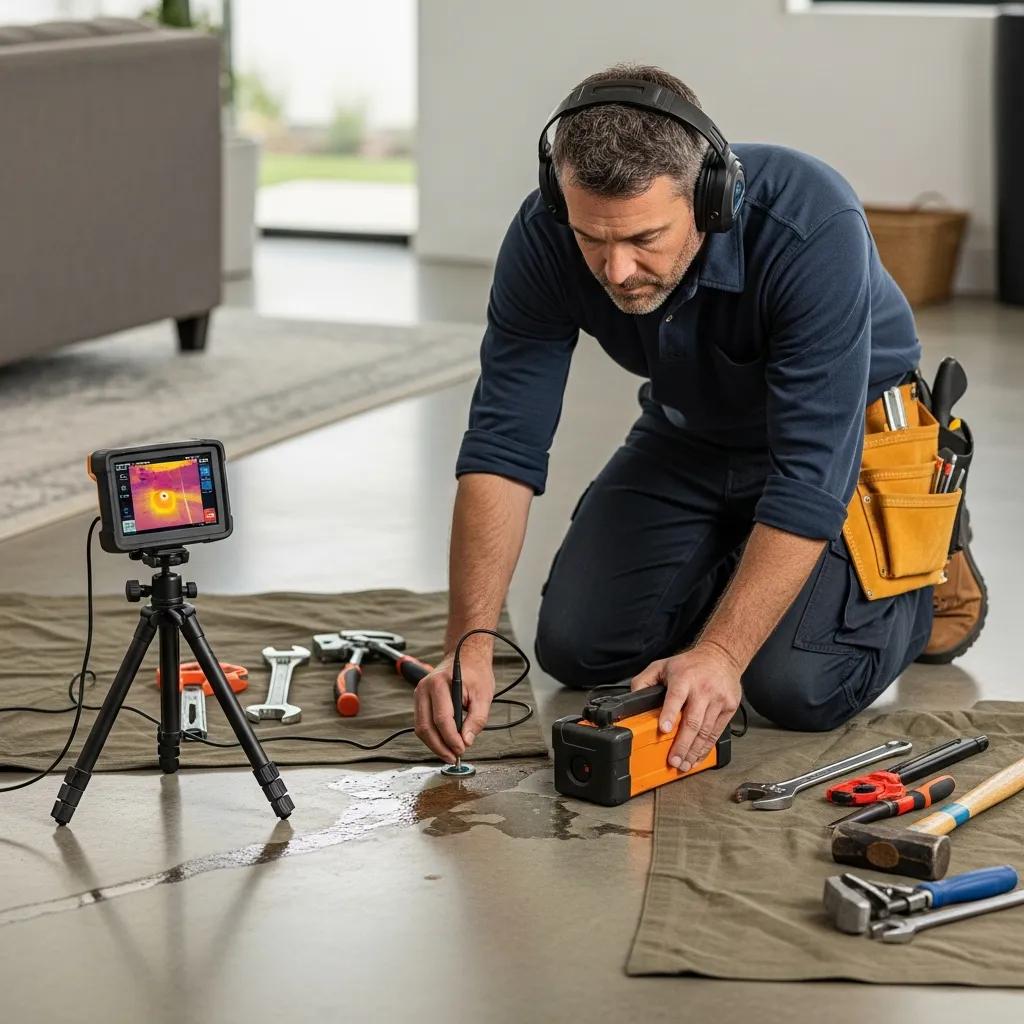
Modern slab leak detection combines acoustic, thermal, and video inspection tools to find leaks accurately while minimizing disruption. Acoustic listening gear detects the specific frequencies of pressurized water escaping pipes and narrows the search area under concrete. Infrared cameras reveal temperature and moisture differences on floors and slab surfaces, guiding technicians to likely zones. Sewer video cameras let technicians see inside accessible drains and sewer lines to confirm pipe condition and exact damage. Acoustic tools pinpoint, infrared maps the surface, and camera inspection confirms the problem — together they produce reliable diagnostics and a clear repair plan.
We pair that equipment with experienced technicians who read the combined data and recommend the least invasive, most durable repair strategy. If you suspect a slab leak, specialized tools plus local know-how let us diagnose quickly and define a repair scope that contains damage and shortens repair time.
How Do Acoustic Listening Devices and Infrared Cameras Work?
Acoustic listening devices amplify and isolate the sound frequencies created by pressurized water escaping a pipe. Technicians sweep floors and use ground microphones to map signal strength, then correlate readings to triangulate the leak location. Infrared cameras detect temperature differences caused by leaking hot or cold water beneath surfaces and produce thermal maps that show warm lines or cool damp spots. Used together, acoustic methods point to precise areas while infrared imaging confirms moisture or heat signatures and helps direct follow-up inspection.
What is the Role of Sewer Camera Inspection in Leak Diagnosis?
Sewer camera inspection entails inserting a flexible video camera into accessible sewer or drain lines to inspect the pipe interior, find cracks, root intrusion, or joint separation, and record the damage for repair planning. For sub-slab plumbing tied to accessible lines, camera footage reveals whether the problem is localized or widespread — information that helps decide between spot repair, lining, or full repiping. The video also helps estimate affected pipe length, plan entry and exit points for trenchless work, and provide clear documentation for homeowners and insurers. Good visuals reduce guesswork and support repair choices that minimize disruption and maximize long-term reliability.
Before running the camera, technicians usually isolate and clean the section for clear footage, then review the recording with the property owner to explain findings and next steps.
Which Professional Slab Leak Repair Methods Are Available and How Do They Compare?

Professional slab leak repairs range from targeted spot excavation to rerouting and trenchless techniques. Each option has trade-offs in invasiveness, cost, and suitability. Spot repair requires digging only at the leak location to repair or replace the damaged segment and is typically least expensive when the leak is isolated and accessible. Rerouting or repiping moves supply lines out from under the slab to accessible areas — a more involved but long-lasting solution. Trenchless repairs, such as pipe lining and pipe bursting, reduce surface disruption and speed restoration but depend on pipe condition and alignment. Comparing these methods helps determine the best fit based on pipe material, age, location, and how much disruption the owner will tolerate.
- Spot repair: Best when a single, accessible leak is found near a surface or utility penetration.
- Pipe rerouting/repiping: Best for aging systems or when you want to avoid future sub-slab plumbing.
- Trenchless repair (lining/bursting): Best for continuous failures where access and pipe condition allow trenchless equipment.
Intro to repair method table: The following table compares common approaches, their invasiveness, and typical use cases to help with decision-making.
| Repair Approach | Invasiveness | Typical Use-case / Pros / Cons |
|---|---|---|
| Spot Repair | Moderate | Pros: Lower cost for an isolated leak; quicker. Cons: Requires excavation at the leak site and may not address broader issues. |
| Pipe Rerouting / Repiping | High | Pros: Long-term solution that avoids the slab. Cons: More labor and longer timeline up front. |
| Trenchless Pipe Lining | Low-Moderate | Pros: Minimal surface damage and faster restoration. Cons: Needs suitable pipe condition and access pits. |
| Pipe Bursting | Moderate | Pros: Replaces pipe without long trenches. Cons: Requires entry/exit pits and may not work with alignment problems. |
What Are the Benefits of Spot Repair and Pipe Rerouting?
Spot repair is a smart choice when diagnostics show a single, reachable failure — it limits excavation, shortens job time, and keeps immediate costs down. For older or repeatedly failing systems, rerouting or repiping moves lines to accessible locations, reducing future slab risk and simplifying maintenance. Key decision points include pipe age and material, extent of corrosion, and how many fittings are compromised. Knowing these trade-offs helps homeowners choose between a lower-cost immediate fix and a more comprehensive solution that lowers lifetime plumbing risk.
How Does Trenchless Repair Offer Less Invasive Solutions?
Trenchless methods like cured-in-place lining and pipe bursting let technicians rehabilitate or replace underground pipes with minimal surface excavation, preserving landscaping and hardscapes. Lining seals the interior of the existing pipe to extend service life without digging a continuous trench; bursting fractures the old pipe while pulling a new one into place through entry and exit pits. These approaches often cut restoration costs and shorten timelines, but success depends on pipe alignment, access, and the extent of damage. When feasible, trenchless options provide faster, cleaner repairs with less disruption to daily life.
What Factors Influence the Cost of Slab Leak Repair in Michigan?
Cost depends on several factors: the leak’s location, the repair method chosen, the extent of pipe damage, excavation difficulty, and regional labor and material rates. Michigan-specific conditions such as freeze-thaw cycles and soil type also affect complexity. Accessibility is a major driver — shallow, near-entry leaks cost less than deep utility runs under thick slabs. Trenchless methods can reduce surface restoration expenses but may carry higher equipment costs. Transparent, itemized estimates that break out diagnostics, labor, materials, excavation, and restoration help homeowners compare proposals and understand why prices differ.
Common cost-influencing factors include:
- Location of the damaged pipe under the slab
- Repair method selected (spot, reroute, trenchless)
- Extent of damage and pipe material
- Need for structural or surface restoration
An on-site inspection gives the most accurate estimate and lets you weigh short-term cost against long-term resilience.
Intro to cost factors table: The table below maps cost factors to their typical impact and notes how each factor affects pricing.
| Factor | Impact on Price | Example Range / Notes |
|---|---|---|
| Pipe location | High | Deep, central runs need more excavation and labor. |
| Repair method | High | Trenchless can reduce surface restoration but has equipment costs. |
| Damage extent | Medium-High | A single crack vs. corroded runs changes material and labor needs. |
| Access/restoration | Medium | Landscaping, concrete cutting, and finishing add to cost. |
| Regional conditions | Medium | Freeze-thaw cycles and soil type affect scheduling and protection. |
How Do Location, Repair Method, and Damage Extent Affect Pricing?
Location influences price because central utility runs under thick concrete or below load-bearing areas require more labor, specialized excavation, and sometimes temporary structural support. Repair method determines material and equipment costs: trenchless technology can save on surface restoration but may have higher upfront equipment rates, while rerouting requires more piping and installation labor. Damage extent directly affects labor and materials — widespread corrosion often leads to repiping rather than repeated spot dig-and-fix jobs. Describing these scenarios helps homeowners judge quotes by value and longevity, not just the bottom-line number.
What Should Homeowners Expect Regarding Estimates and Pricing Transparency?
Expect an on-site inspection, a written, itemized estimate, and a clear scope that separates diagnostic fees, labor, materials, excavation, and restoration costs, plus details on warranties or guarantees. A good estimate lists assumptions (like access availability), possible change orders, and alternative approaches — spot repair vs. reroute vs. trenchless — and explains their cost implications. Ask about timelines, required equipment, and contingency plans for unexpected finds to avoid surprises. When comparing contractors, look for clear communication about cost drivers and a willingness to explain why a recommended approach best fits your property.
A numbered checklist can help homeowners prepare for estimate conversations:
- Request an itemized written estimate with scope and exclusions.
- Ask which diagnostic methods will be used and why.
- Clarify warranty/guarantee terms and restoration responsibilities.
With clear estimates in hand, you can compare value — not just the lowest price — to ensure a durable outcome.
Why Choose Frost and Kretsch Plumbing for Your Slab Leak Detection and Repair Needs?
Frost and Kretsch Plumbing is a local, family-owned company offering fast, professional slab leak diagnostics and repairs for homes and businesses across Macomb, Oakland, and Wayne counties. Our team includes licensed and master plumbers who use advanced equipment — acoustic listening devices, infrared cameras, and sewer video cameras — and provide 24/7 emergency response to limit damage quickly. We emphasize transparent pricing, a 100% satisfaction guarantee, and minimizing property disruption through trenchless options when appropriate. For reliable slab leak service in the region, contact Frost and Kretsch Plumbing to schedule a diagnostic inspection and estimate.
How Do 24/7 Emergency Services and Licensed Experts Provide Value?
24/7 emergency service shortens the window for progressive soil erosion, mold growth, or structural damage, letting us diagnose and contain leaks before they worsen. Licensed and master plumbers bring code knowledge and diagnostic experience that reduce the risk of improper repairs and repeat work. Fast containment and expert repair planning save time and money by avoiding prolonged moisture exposure and selecting the most durable repair option. That operational readiness and professional licensing protect both your property and your investment.
What Guarantees and Local Expertise Differentiate Our Services?
We back our work with a 100% satisfaction guarantee, clear pricing practices, and deep local knowledge of Michigan plumbing challenges across Macomb, Oakland, and Wayne counties. Our familiarity with regional soil behavior, freeze-thaw impacts, and common residential and commercial layouts leads to more accurate diagnostics and repair planning. Combining advanced tools with licensed technicians means our recommendations are evidence-based, as noninvasive as possible, and focused on long-term reliability. Property owners benefit from this mix of local experience, technical skill, and straight-forward service commitments.
Frequently Asked Questions
What preventive measures can homeowners take to avoid slab leaks?
Homeowners can reduce slab leak risk by regularly inspecting visible plumbing for corrosion or wear, keeping gutters and grading working so water drains away from the foundation, and considering a water softener if hard water is accelerating pipe corrosion. Maintaining steady indoor temperatures in winter also helps minimize freeze-thaw stress on buried pipes — an important factor in Michigan’s climate.
How long does it typically take to repair a slab leak?
Repair time varies by method and damage. A straightforward spot repair can take a few hours; more complex rerouting or trenchless repairs may take a day or longer. Accessibility, the need for excavation, and materials used all affect the timeline. Your plumber can provide a more accurate estimate after an on-site inspection.
Are there any long-term effects of slab leaks if not addressed promptly?
Yes. Left untreated, slab leaks can weaken the foundation, cause costly structural repairs, encourage mold growth with associated health risks, and lead to higher water bills and damage to floors and walls. Early detection and repair greatly reduce these long-term consequences.
What should I do if I suspect a slab leak?
If you suspect a slab leak, start by watching your water meter for continuous flow when all fixtures are off. Check for warm spots, damp areas, or sudden increases in your water bill. Once you’ve gathered these observations, call a licensed plumbing professional for a full inspection and diagnostic testing using acoustic, thermal, or camera tools.
How can I choose the right plumbing service for slab leak repairs?
Choose a licensed, insured plumber with slab leak experience. Read reviews, ask about diagnostic tools and repair methods, and request detailed, itemized estimates that spell out timelines and warranties. Prefer contractors who explain options — spot repair, reroute, trenchless — and why one approach fits your property better than another.
What are the environmental impacts of slab leak repairs?
Prompt repairs conserve water and reduce soil erosion from ongoing leaks. Trenchless methods minimize surface disruption and preserve landscaping, which lowers material waste. When selecting a contractor, ask about eco-friendly practices like proper disposal of old materials and minimizing use of harmful chemicals during the work.
Conclusion
Finding and fixing slab leaks quickly protects your property and prevents costly, long-term damage. Advanced diagnostics — acoustic listening, infrared imaging, and sewer cameras — combined with experienced technicians allow accurate detection and repair plans tailored to your situation. Choosing Frost and Kretsch Plumbing gives you local expertise, transparent pricing, and options that minimize disruption while delivering durable results. Contact us today to schedule a diagnostic inspection and protect your home or business from the hidden risks of slab leaks.